e-Newsletter Tarzana - Shabbos Parshas Shoftim

Having trouble viewing this email? View it online

Chabad of Tarzana• 818-758-1818 • ChabadofTarzana.com
E- NEWSLETTER
In loving memory of Rabbi Joshua B. Gordon ob"m 
 

בס"ד
  What's New @ Chabad

Kiddush sponsored by The Boganim Family in honor of the Ufruf of their son Menachem - Mazel Tov! 

To sponsor a Kiddush please email  [email protected] or call Meredith at 818-758-1818.


WEEKLY TORAH CLASSES

  • Wed Nights: A Chassidishe Derher - Men's Class
  • Thurs Nights: Beis Medrash Learning - Men's Class
  • Shabbos: 
        - Inside Information - Chassidus on the  Parsha
        - Moshiach & Geulah - Women's Class 
  • Sunday Mornings: Tanya - Women's Class 

PARSHA RESOURCES
Click here for a comprehensive library of articles and discussions about this week's Parsha. Please remember to print them before Shabbos.

* * *
SHABBOS SERVICES

  • Friday afternoon Mincha/Kabbolas Shabbos - 7:35 pm
  • Chassidus Class - 9:15 am 
  • Shabbos morning Shacharis - 10:00 am
  • Jr. Congregation - 11:45 am
  • Kiddush - Following Musaf
  • Mincha - Following Kiddush
  • Women's Class - Following Kiddush 
  • Maariv - 8:40 pm 

* * *

DURINGTHE MONTH OF ELUL

We recite the paragraph of L'Dovid Hashem  Ori (Psalms: 27) daily during Shacharis & Mincha. 

We hear the sounding of the 10 blasts of the Shofar each day.

The Baal Shem Tov instituted the custom of reciting 3 additional chapters of Tehillim (Psalms) daily from The 1st day of Elul through Yom Kippur, completing the entire book.

* * *

Reserve you High Holidays seats now.  
Click here for reservations.

* * *
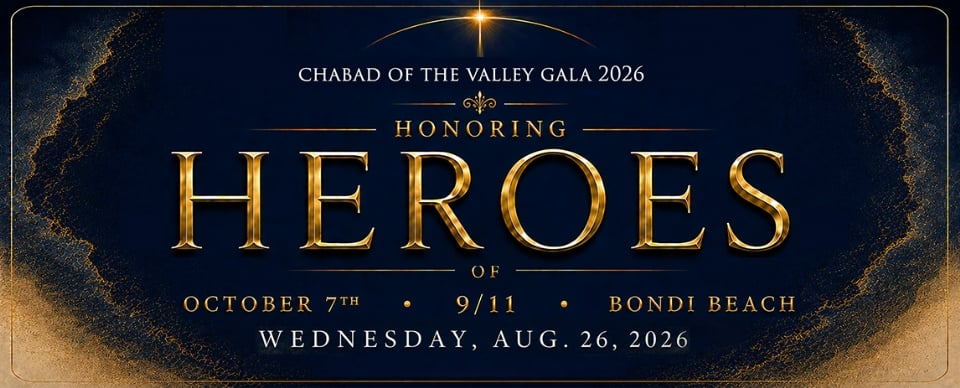
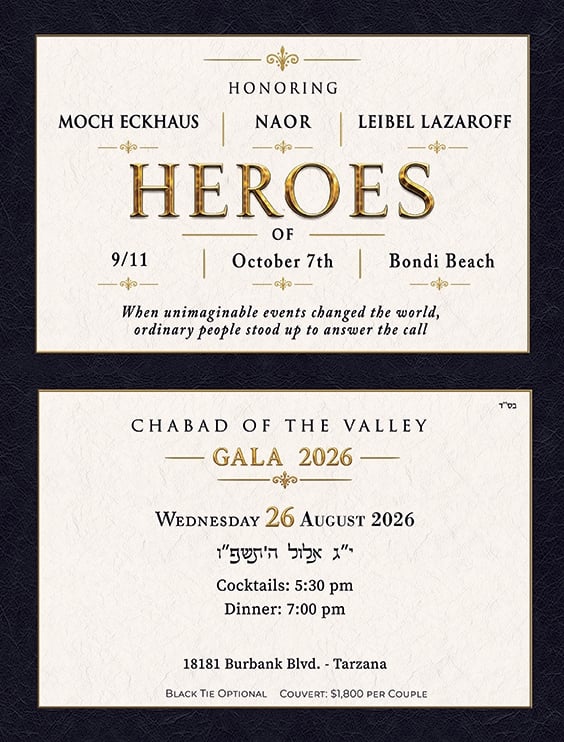
CHABAD GALA 2026
To reserve go to  
chabadofthevalley.com/gala

* * *

 
A thought for the week
 

Most of us don’t need to be told that honesty matters. We know lying is wrong, and we try to live truthfully. Sure, there are moments when we’re tempted to bend the truth a little, or avoid saying everything to keep the peace. But overall, we value honesty.

This week’s Torah portion pushes us to look at a place where honesty is often tested: when attempting to promote an ideal that we feel might need to be watered down.

We all do it. A child asks a hard question, and instead of explaining, we simplify a little too much or even make something up. Or we promise a reward to get cooperation, without fully thinking it through. Later, when we don’t follow through, we justify it to ourselves. But in a child’s eyes, it’s simple. You said something would happen, and it didn’t.

Honesty isn’t just about avoiding lies. It’s about building trust. When people know they can trust what we say, they’re open to hearing more.

The Torah reminds us that teaching, whether to children or adults, must always be rooted in truth. We can simplify and we can meet people where they are, but we can’t distort.

And when Torah is taught properly, without cutting any corners, the teacher gains the student's trust, something that can never be taken for granted.

Shabbat shalom,

 
  Ralph's Community Contribution Program

To Use the Ralphs Community Rewards Program:

  • Go to Ralphs.com
     
  • Click on “Menu” on the left side of the screen
     
  • Scroll down to “Savings” (after “Departments”)
     
  • Click on “Savings”
     
  • Scroll down to the bottom to “Community Contribution Program” and follow the instructions for linking your card to Chabad of the Valley.
     
  • Click on “Link to shopper’s card” and write our organization’s name (Chabad of the Valley) and the organization’s number (MG222).


This Week @ www.ChabadoftheValley.com
   
By the Numbers
10 Wild Facts About Bears in Judaism
They once roamed the Land of Israel and are mentioned quite often in the Bible and Talmudic literature.
   
Your Questions
Am I Responsible if My AI System Causes Damage?
Although the Torah's laws of damages existed long before computers, they provide categories and insight through which the laws and ethics of new technologies can be analyzed.
   
Quiz
Take the Hebrew Alphabet Quiz
Do you know your aleph from your bet? We bet you can do this one!
   
Freeman Files
Who Created G‑d?
The Creator of all boundaries is unbounded by any definition. Otherwise, He too would require a creator.
 
Chabad-Lubavitch News from Around the World
   
North America
American Airlines Honored For Compassion Shown Ahead of Slain Bondi Rabbi’s Funeral
   
North America
Park East Synagogue and Chabad of the Upper East Side Announce Historic New Chapter
   
North America
Once a Summer Getaway, Ontario Lake Town Now Has a Jewish Home for All Seasons
   
North America
As Wildfires Ravage Spokane, Chabad Assists Displaced Families


Candle Lighting Times for
Tarzana:
Shabbat Candle Lighting (Shoftim):
Friday, Aug. 14
7:24 pm
Shabbat Ends:
Shabbat, Aug. 15
8:25 pm
Torah Portion: Shoftim

Pirkei Avos: Chapter 6

Shabbat Schedule

Friday Evening
Mincha - 7:35 PM

Shabbat Morning
Torah Class - 9:15 am
Latest Shema - 9:35 AM
Shachris - 10:00 am
Jr. Cong - 11:45 am
Kiddush - Following Musaf
Mincha - Following Kiddush
Women's Class - Following Kiddush

Motzei Shabbos
Shabbos Ends - 8:25 PM
Maariv - 8:40 PM

Weekly Schedule

Shacharis at Chabad of Encino
Sunday - 8:00 am
Monday - Friday - 7:00 am & 8:00 am

Mincha at Chabad of Tarzana
Sunday - Thursday - 7:35 pm

Quote of the Day
Answer not a fool's foolishness, lest you come to resemble him
— Proverbs 26:4
Parshah

Parshat Shoftim

The name of the Parshah, "Shoftim," means "Judges" and it is found in Deuteronomy 16:18.

Moses instructs the people of Israel to appoint judges and law enforcement officers in every city. “Justice, justice shall you pursue,” he commands them, and you must administer it without corruption or favoritism. Crimes must be meticulously investigated and evidence thoroughly examined—a minimum of two credible witnesses is required for conviction and punishment.

In every generation, says Moses, there will be those entrusted with the task of interpreting and applying the laws of the Torah. “According to the law that they will teach you, and the judgment they will instruct you, you shall do; you shall not turn away from the thing that they say to you, to the right nor to the left.”

Shoftim also includes the prohibitions against idolatry and sorcery; laws governing the appointment and behavior of a king; and guidelines for the creation of “ cities of refuge” for the inadvertent murderer. Also set forth are many of the rules of war: the exemption from battle for one who has just built a home, planted a vineyard, married, or is “afraid and soft-hearted”; the requirement to offer terms of peace before attacking a city; and the prohibition against wanton destruction of something of value, exemplified by the law that forbids to cut down a fruit tree when laying siege (in this context the Torah makes the famous statement, “ For man is a tree of the field”).

The Parshah concludes with the law of the eglah arufah—the special procedure to be followed when a person is killed by an unknown murderer and his body is found in a field—which underscores the responsibility of the community and its leaders not only for what they do, but also for what they might have prevented from being done.

Learn: Shoftim in Depth
Deep-Dive: Shoftim Parshah Columnists
Prep: Devar Torah Q&A for Shoftim
Read: Haftarah in a Nutshell
Play: Shoftim Parshah Quiz